
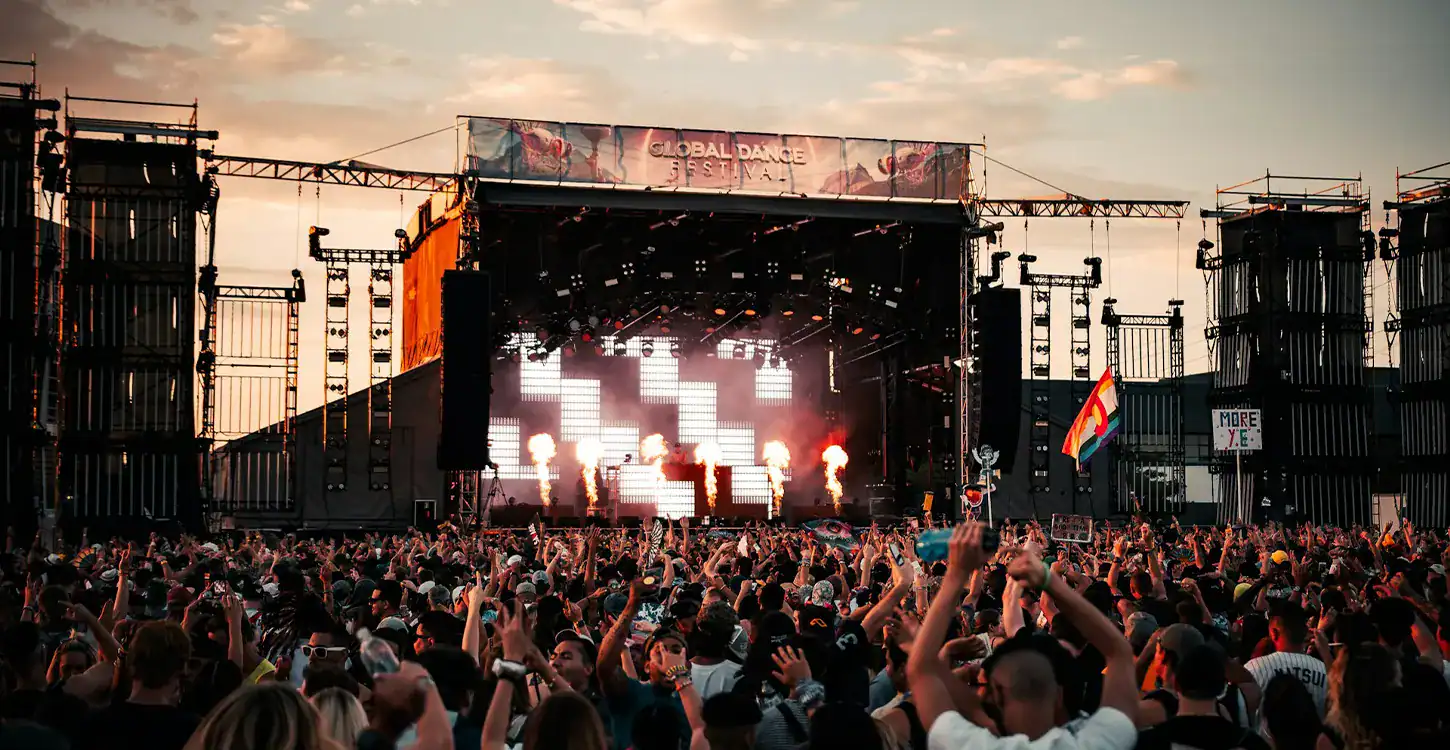
From under-specified flooring to last-minute logistics, the most expensive decisions in event infrastructure are often the ones made earliest — or not made at all.
Event infrastructure rarely makes the headlines, until something goes wrong. A surface that shifts under vehicle traffic. A power distribution system that can’t handle peak load. Structures approved for one site that don’t meet the requirements of another. When temporary infrastructure fails, the consequences aren’t just operational – they affect safety, reputation, and the bottom line.
The good news is that most of these failures are preventable. The majority stem not from bad luck, but from avoidable specification errors, planning gaps, and the false economy of choosing a product-only supplier over an experienced infrastructure partner.
Here are five of the most common, and costly mistakes we see across the events sector.
Mistake #1: Specifying Infrastructure Based on Product Name Rather Than Application
Temporary flooring, fencing, and power distribution are broad categories. What works at a music festival won’t necessarily work at a stadium build programme, and what’s appropriate for a summer event on dry ground may be completely wrong for a waterlogged field in autumn.
The error here is familiar: a procurement team or event producer specifies a product they’ve used before, or one they’ve seen at another event, without fully assessing the demands of the current application. Ground conditions, load requirements, pedestrian versus vehicular use, dwell time, installation access – all of these variables affect which solution is right.
The question is never just ‘what product do we need?’ It’s ‘what does this surface need to do, where, for how long, and under what conditions?’
The real cost: Incorrect specification leads to product failure, emergency replacements, and in some cases, health and safety incidents. Last-minute sourcing under pressure is always more expensive than planning correctly from the outset.
Mistake #2: Treating Infrastructure as a Late-Stage Decision
Infrastructure planning is frequently treated as something to resolve once the more exciting elements of an event are locked in – the headline acts, the brand activations, the hospitality programme. By the time someone turns their attention to ground protection, access routes, or temporary power, the event layout has already been fixed and the budget is under pressure.
This sequencing problem creates a cascade of issues. Site layouts designed without reference to infrastructure requirements often need to be revised. Access routes that haven’t been assessed for load-bearing capacity may need emergency reinforcement. Power requirements that weren’t modelled early enough lead to generators that aren’t scaled correctly or cabling runs that don’t fit the site.
Infrastructure should inform the event design, not the other way around. Bringing in a specialist partner at concept stage costs nothing extra, and routinely saves significant sums at delivery.
The real cost: Late-stage infrastructure decisions compress procurement timelines, limit product availability, and eliminate the opportunity to value-engineer solutions. They also increase the risk of specification errors when decisions are made under pressure.
Mistake #3: Underestimating Ground Conditions and Load Requirements
Ground condition assessment is one of the most consistently undervalued parts of temporary event infrastructure planning. It’s also one of the areas where specification errors are most likely to result in visible, expensive failure during the event itself.
The variables are more complex than they appear. Ground bearing capacity changes with rainfall, season, and sub-surface conditions that aren’t always visible on site. Vehicle weights vary enormously – a service vehicle on an access route may be significantly heavier than the load calculations assumed. And some surfaces that appear stable on a dry site walk can become hazardous under the sustained traffic of a multi-day event.
Common specification failures include:
- Relying on visual inspection rather than ground bearing assessments to determine flooring specification
- Applying a standard loading figure without accounting for dynamic loads from vehicles turning, braking, or operating on slopes
- Failing to account for cumulative wear over multi-day events, particularly in high-footfall areas or vehicle access routes
- Specifying a lighter-duty product where a heavy-duty solution is required, based on price rather than performance
The real cost: Surface failure mid-event requires emergency remediation, disrupts operations, and in worst cases forces closures. Replacement costs under operational pressure can be three to five times the cost of correct specification at the planning stage.
Mistake #4: Splitting Infrastructure Procurement Across Multiple Suppliers Without a Lead Coordinator
For large-scale events, it’s common for different infrastructure elements to be procured separately; flooring through one supplier, fencing through another, temporary power through a third, welfare units through a fourth. On the surface, this approach appears to offer competitive pricing and flexibility. In practice, it frequently creates coordination failures that cost more than any individual saving.
When no single supplier has oversight of the full infrastructure picture, gaps and clashes emerge. Loading-out sequences that conflict with each other. Install schedules that assume the same access routes simultaneously. Power solutions that weren’t designed around the final site layout. Fencing configurations that obstruct planned cable routes.
The event organiser, or their production manager, ends up absorbing the coordination burden that a full-service infrastructure partner would have managed as a matter of course.
A product supplier fulfils an order. An infrastructure partner manages the outcome. The distinction matters most when site conditions change, timelines compress, or something unexpected happens on install day.
The real cost: Coordination failures at installation add unplanned labour hours, extend site-in periods, and can push back opening times. On a large event, the cumulative cost of poor coordination across multiple suppliers can exceed the entire infrastructure budget of a comparable event run through a single experienced partner.
Mistake #5: Failing to Account for Removal, Reinstatement, and Post-Event Liability
Post-event obligations are frequently underweighted in infrastructure planning. The focus on site-in and operational delivery means that site-out logistics, ground reinstatement requirements, and post-event liability clauses can be overlooked until they become urgent problems.
This manifests in several ways. Products specified without considering ease of removal can significantly extend site-out periods with associated labour costs and venue penalties. Ground protection solutions that weren’t appropriate for the site conditions may leave damage that triggers reinstatement costs. And procurement arrangements that didn’t clearly allocate responsibility for removal can result in disputes between organiser, venue, and supplier.
Questions that should be asked at specification stage… and often aren’t:
- What are the venue’s reinstatement requirements, and which infrastructure products meet them?
- Who is responsible for removal, and is that clearly contracted?
- What are the penalty clauses for extended site occupancy, and how does the infrastructure schedule interact with them?
- Has the removal sequence been planned with the same rigour as the installation sequence?
The real cost: Extended site-out periods and reinstatement claims are a significant and largely avoidable cost for events companies. They are almost always the result of planning gaps that a full-service infrastructure partner would identify and address as a standard part of project delivery.
The Common Thread
These five mistakes share a root cause: treating temporary infrastructure as a commodity purchase rather than a managed service. When infrastructure is bought on price alone, without reference to application, site conditions, coordination, or post-event obligations, the savings achieved at procurement stage are routinely dwarfed by the costs incurred at delivery.
The events companies that manage infrastructure most effectively, and most cost-efficiently, are those that engage experienced partners early, provide full project context, and treat infrastructure planning as integral to the event design process rather than supplementary to it.
The most expensive infrastructure decision is usually the one made in a hurry.
About The Box Group
The Box Group is a full-service temporary infrastructure partner serving the events, stadium, construction, military, and humanitarian sectors. We work across the full project lifecycle – from early-stage specification and site assessment through to installation, management, and removal, providing a single point of accountability for complex infrastructure requirements. Explore our full range of solutions at thefloorbox.com.